
Navigating Success
As the landscape of HIV care continues to evolve, so must the way services are delivered. At Chicago House, that commitment to innovation led to the launch of Peer Health Navigation, an enhanced case management model that pairs clients with trained peer navigators who provide hands-on support while drawing from their own lived experiences.
Unlike traditional service models that rely solely on professional expertise, Peer Health Navigation recognizes the value of shared experience and the trust it can build. Peer navigators help participants set goals, build confidence, and identify their own strengths while navigating complex systems and personal challenges.
“The peer health navigators foster self-determination through goal setting and affirmations,” said Mikey Brown, Program Manager. “With their lived experience, they can sympathize with program participants and help them find their voice while navigating the reality of the systems in place. The peers help clients essentially help themselves by promoting self-confidence and using harm reduction approaches that uplift and empower participants.”
"Over the years, Chicago House has seen the complexity and fragility of our clients increase, making our current case management model less relevant to meeting the needs of today's clients," said Judith Perloff, Chief Program Officer. "Clients' need for more hands-on help with housing navigation and mental health support is best met by a peer who has the time to devote to clients while also serving as a role model and source of inspiration. Case Management that is enhanced with the use of peer support navigators leans in on different skill sets to better address the complex barriers our clients face."
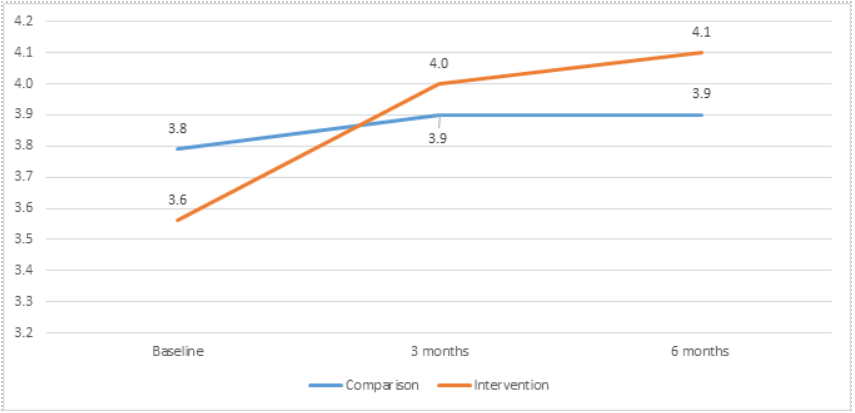
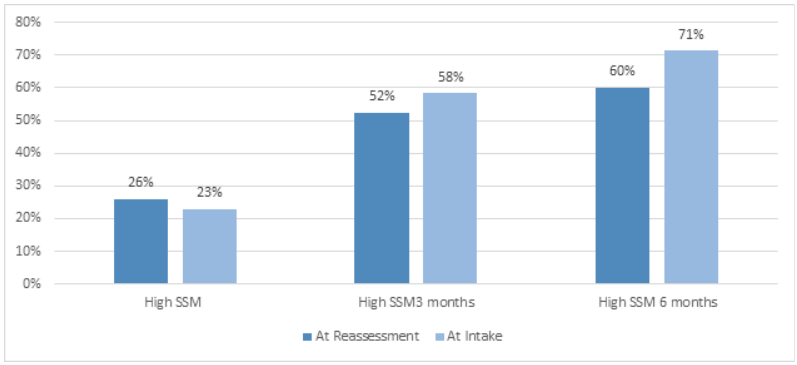
Since launching the pilot in 2024 in partnership with Illinois Institute of Technology and the University of Illinois Chicago, early findings have reinforced the value of this approach. The evaluation compared 65 participants assigned to either traditional case management or case management enhanced with peer support, ensuring both groups began the study with similar demographics and baseline outcomes.
While participants in both groups made progress, those working with peer navigators experienced significantly larger and faster gains in self-sufficiency. By six months, participants receiving peer support increased their average Self-Sufficiency Matrix (SSM) score from 3.6 to 4.1, compared with an increase from 3.8 to 3.9 among those receiving traditional case management. Measured on a 5-point scale, the difference in improvement between the two groups was statistically significant.
The improvements extended beyond average scores. After six months, 71% of participants receiving peer support achieved a high level of self-sufficiency, compared with 60% of those receiving traditional case management. Researchers also found that the peer navigation model was particularly effective at helping participants build the skills and stability needed to achieve long-term success.
Housing outcomes remained strong across both groups, with 95% of participants in stable housing after six months and half connected to housing within approximately one month. Researchers noted that participants with the greatest needs sometimes spent additional time working with peer navigators before securing housing, suggesting that peer support helps address underlying barriers to long-term stability rather than simply accelerating placement.
"Peer Health Navigation has underscored what grounds so many of us in this work: the importance of human relationships," said Garrett White, Director of Clinical and Compliance Services. "Preliminary findings show a statistically significant improvement in clients' ability to increase self-sufficiency more quickly by pairing housing needs with a Supportive Housing Case Manager and health needs with a Peer Health Navigator. Most promising is that, by reimagining how we provide support, we are better equipped to meet community members where they are while creating lasting structural change."
These findings reinforce what our team has seen firsthand: when clients are paired with someone who understands their experiences and can provide individualized guidance, they are better equipped to navigate complex systems and move toward independence. By continuing to strengthen Peer Health Navigation, Chicago House is investing in a model of care that fosters trust and supports healthier futures.